Pinteresting?

On Friday I joined Pinterest and it promptly swallowed my weekend. If you’re not familiar with Pinterest it’s a somewhat controversial site which allows you to ‘pin’ images from the net to virtual pinboards. Gathering shiny things from the net like virtual magpies you can easily and quickly make collections of inspirational images. The controversy is around copyright violation. The site has a couple of rather flimsy figleaves it attempts to hide behind but the fact is that a fair amount of the ‘pinning’ on the site is not approved of by the image owners. This is a source of horror for professional photographers in particular and until last weekend I was avoiding the site for my own ethical reasons.

However I’ve started using it. Why? Because Pinterest has been the largest single source of referrals to my blog recently – even before I joined it. Yes, this means that some of my images were being pinned without my consent but honestly it’s not like I’m ever going to make money from my photos anyway so, whatever. And also – pretty things and the opportunity to arrange pretty things. Deep, huh?

In order to use Pinterest without my conscience eating me nibble by nibble I’ve come up with some rules which will help me to use it without violating people’s copyright.

I only pin in these scenarios:

1) The image is my own or I know that the original pinner is the owner of the image.

2) The link to the source works and the source encourages or allows pinning of their images and I am reasonably confident that the source is the owner of the image.

3) The source is a shop. This is based on the assumption that free advertising is usually appreciated.

This isn’t foolproof but it seems to be a reasonable compromise. I’ve only been on it a few days and the beautiful images I’ve not pinned because they were blatantly stolen would be enough to make you weep.

If, like me, you are a gardening blogger who is happy for others to use your images then it might be worth at least enabling the ‘share’ button for Pinterest.

So, dear readers, do you use Pinterest? Do you have your own set of rules for using it well? Do you have any thoughts on the issues regarding the site? I could rant about this for pages and pages but I’ll save you the horror and stop now and distract you with -

Look! Tulip!

Tulipa 'Professor Roentgen'

Tulipa ‘Professor Roentgen’

Plant of the Month – May 2013

Anemone sylvestris

Anemone sylvestris

Every May the Anemone sylvestris emerge and put on a glorious show for a few weeks, starting about the end of April. They are rather like our native wood anemone (Anemone nemorosa) on steroids having similarly divided leaves and nodding white flowers but reaching a foot or so tall instead of a few inches.

I hear rumours of repeat flowering in autumn although mine have never acheived this feat. They spread about quite a bit and I understand that in lighter soils than ours they can be a bit of a pest, but such a pretty pest.

Anemone sylvestris

Anemone sylvestris

Natives of meadows and woodlands they are happy even in quite deep shade, though here they are in partial shade. One or two clumps are in full sun and although they are a bit less vigorous than the ones in the shadier spot, they seem to be doing ok.

Nodding in clusters with the church in the background they bring to mind a crowd of choirboys with their heads bowed. If my Dad’s tales of being a choirboy are anything to go by I shall soon find them behind the shed having a crafty ciggie.

Lathyrus vernus

Seeing as I’ve completely messed up my blog schedule and haven’t done a Plant of the Month for ages I thought I’d do a profile of a lovely little plant for this time of year and then I’ll do my best to pull my socks up and get back into the blog driving seat this month. The winter blues ought to be well over by now!

Lathyrus vernus

Lathyrus vernus

The gorgeous blue-purple pea flowers of Lathyrus vernus are a rich, saturated colour and they go wonderfully with late flowering narcissus and miniature tulips. The young growth uncoils itself in an almost fern-like way in early spring and after flowering the seed pods twist into brown helixes after they burst, giving some interest for the keen-eyed beyond flowering season; otherwise it is quite unobtrusive for the rest of the year.

Lathyrus vernus likes a fertile soil and sun or partial shade and forms a clump 30-45cm tall and wide. It will self seed but not in a particularly bothersome manner. There are paler, wishy-washy coloured versions available but why would you?

Lathyrus vernus with Tulipa 'Little Beauty'

Lathyrus vernus with Tulipa ‘Little Beauty’

Also, its common name is Spring Vetchling and that’s just cute. Anything that sounds like a minor enemy in a fantasy roleplaying game can have space in my garden.


Finally!

Spring has sproinged! And about bloody time too. I actually felt motivated to take some pictures:

Narcissus 'Jetfire'

Narcissus ‘Jetfire’

The pretty little pansy in the bottom is Viola ‘Brushstrokes’ which I grew from seed to brighten the Spring containers.

Blue hyacinths

These hyacinths are some I planted out after using them in the house and their label has gone missing (if there ever was one… oops). The garden gets more and more hyacinths, narcissus and miniature irises every year because each season I grow them for Spring containers and then plug gaps with them once they’re over.

And you just can’t beat sunlit daffs in April:

Daffodils

What I can’t insert in the post is the smell of freshly mown grass. Take a deep breath and… ahhhhh.

Plant of the Month – March 2013

I’ve been trying to convince myself and my colleagues that it’s Spring. ‘Look’ I say, hopefully as the wind bites my face, ‘I can prove it because we’ve got these little friends.’ and I point to the Primroses.

Primula vulgaris

Primula vulgaris AKA Primrose

They brighten dingy corners and once they are done the leaves sit there being fairly unobtrusive. They cope with most soil as long as it’s not dry, and like sun or partial shade. I often dig up a few clumps and spread them about the place as I do with snowdrops.

When I was a child I used to pick their flowers and put them in tiny little vases. As an adult I still do this and they look particularly lovely with heartsease or other small violas.

Primula vulgaris 2

It’s quite common to see the pink variety available (Primula vulgaris ‘Rosea’) and we have white ones in various spots in the garden but really, I love the gentle yellow ones best of all.

The Good, The Bad and the Beautiful – February 2013

The Good

I’ve been coming home stinking of wood smoke for much of the latter half of the month. FarmGuy, MsV and I have been coppicing a mostly elm hedge that was massively overgrown, saving the trunks for logging and burning the brush. So lots of fires! I love fires ~cackle~

Bonfire

Me? Pyromaniac? No…

After all the joking about my previously undetected pyromania I came home to a car on fire in my street which was a much more worrying fire (and no it wasn’t vandalism thankfully).

The Bad

I’ve been rather quiet on the blogging front. I’m not sure whether this is because it’s not an exciting time of year for the garden or because I’m doing some fiction writing and am therefore getting my writing ‘fix’ elsewhere. I’m not even reading many blogs – sorry everyone!

The Beautiful

This Daphne has been smelling gorgeous throughout the month.

Daphne Bholua 'Jaqueline Postill'

Daphne Bholua ‘Jaqueline Postill’

It’s a little chlorotic on our slightly alkaline clay but otherwise seems fairly happy. Quick explanation – Chlorosis is yellowing of the leaves due to iron deficiency. Some plants can’t take up iron as effectively when grown in soils with a high pH and so plants which require a low pH often end up with the symptoms of iron deficiency.

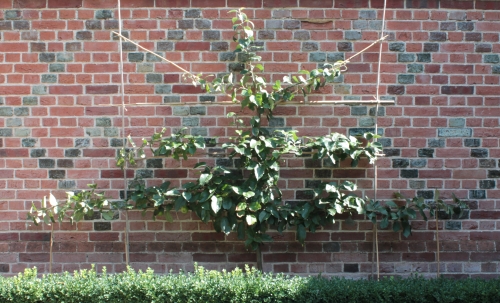
How to Train an Espallier Apple Tree

Espalliered apple trees are a beautiful and fairly compact way to grow apples in the garden. They need the support of a system of wires or similar  (you’ll notice in the pics mine are getting by on a cane framework at the moment – I’ve been nagging for the wires to appear for ages… ) but they don’t have to be against a wall – they make an attractive divider in the garden. If you are going for a wall, South and West facing walls are best. On North facing walls the trees don’t get enough sun and on East facing walls the early morning sun can melt frosted flowers too quickly, damaging them more than if they’d had the chance to slowly warm as they would on a West wall.

When buying your trees you need them to be on a dwarfing root stock and it’s best to mention to the nursery that you are planning an espallier – I didn’t and their initial form had to be overcome somewhat. A maiden whip (single stem) is a good starting point. Also you need your flowers to be fertilised, so if you are growing more than one ensure they are from compatible pollinating groups and if only growing one tree you need a self-fertile variety. When choosing a variety avoid any tip bearing trees – you need spur-bearing varieties. You can espallier prune pear trees, but stone fruit trees (cherry, plum etc) perform better with fan training.

Prune your apple trees in late winter/early spring using clean, sharp tools and angle any cuts so that water will not sit on them. Always cut to a bud that’s facing in a useful direction – not into the wall or the main stem for example.

I’ll start with a pruning diagram and then explain step-by-step. If you have a new tree, or one that is younger than mine you simply complete the steps until you run out of branches!

Espallier pruning diagram

Espallier Pruning

1. Decide at what level you want your next tier of horizontal branches. I’ll be going for four layers on this tree. Three or four is a good number, most won’t manage more because of the dwarfing root stock. You can have just one for a ‘stepover’ tree.

2. Making the new tier of branches. Cut the main growing stem above the third bud above your desired branch level and tie to the support. These three buds will form the new main stem and the two branches. If this is to be the uppermost tier, cut above two buds as you won’t need a new upright stem.

Espallier pruning the top tier

Making the next tier

Throughout the next year - tie the new lateral shoots to canes at 45 degrees to the horizontal as they grow.

3. The New Laterals. Lower the new lateral shoots to the horizontal wire (gently!) and tie them in. Cut these branches back by a couple of inches to an upward facing bud.

In late summer - cut back shoots that have arisen from the laterals and the stem to 3 or 4 leaves.

4. The established laterals. Cut back the shoots you trimmed in the summer further to one or two buds. Also entirely remove any crowded or awkwardly placed shoots. Trim the tip of the lateral back by a couple of inches to an upward facing bud if the tree is still growing into its space, or further if it’s filled its allotted space. Replace all ties.

Don’t skip the summer pruning – if you do it all at once in winter you may force your tree into biennial bearing and then you’ll miss out every other year until you can coax it back to annual bearing.

And that’s it!

Pruned tree

Finished!

The Good, The Bad and the Beautiful – January 2013

The Good

My greenhouse has some welcome lodgers…

Toad

My new best buddy

MsV and I discovered this guy and friends by nearly stepping on them while giving the greenhouse a tidy. Here’s hoping they scoff any slugs that might have snuck in!

The Bad

Boring winter jobs. We’ve had some snowy weather early on this month and I do really love cold weather – it’s just a shame it forces me onto boring tasks like helping MsV and FarmGuy with wood splitting for three days solid. It could have been worse, I could have been washing out all the plastic pots…

The Beautiful

The warm weather we’ve had for the last week of January has really brought everything on and it’s definitely feeling springlike out there.

Snowdrops

Yay! Snowdrops!


The New English Glossary of Snowabulousness

Recently I was standing in the garden as flakes drifted down around me considering that we have a totally insufficient vocabulary when it comes to snow. Yes, we have lots of lovely adjectives, adverbs and swear-words that can be both or either but it’s not good enough dammit. So I have come up with a few new words to help with the lack of snowcabulary.

WARNING!! Accumulations of sarcasm ahead!! WARNING!!

First a relevant picture to illustrate our given topic:

Snowy trees

Ooh look, snow in Winter.

Snuprise! – Exclamation given when we get snow in Winter. Hold on to your seats for shocking news everyone but this happens nearly every year. Blimey.

Snizzle – The snow equivalent of drizzle. If it continues as it is, it will never really work itself into an accumulation. I am a wierdo who loves snow and if I’ve been promised snow by important people like the BBC I have been known to respond to snizzle by shaking a fist at the sky and shouting ‘You call this snow?!’

Snitting – Even feebler than snizzle, this is when one solitary, miniscule flake drifts down every few moments. It sometimes leads to people looking heavenward, pointing to the horizon and saying ‘it’s black over there’ in an ominous tone of voice and checking the met office weather app more than is ever strictly necessary.

Splotting – Vast wet flakes the size of a well-known brand of crisps floating down fast and thick but melting immediately because they’re so soggy and it’s several degrees above freezing. Hugely disappointing to a snow lover like me – like waving a pint of real ale in front of me and then throwing a pint of Fosters over my head.

Snowflizz – Small dusty flakes coming down quite fast. If it keeps it up for hours and it’s cold, snowflizz can quietly and sneakily work up to proper duvet-like accumulations.

Snidiot – the bloke who overtakes you on a snowy road in a big 4×4 who you secretly hope you’ll find in the ditch round the next bend. Except you don’t because then you’d have to stop and check he wasn’t actually dead and other such inconveniences.

Flakefrit – the state of being terrified of snow. People who are flakefrit drive at -3 miles an hour and overuse the accelerator when trying to get moving and the brake when trying to slow, thereby managing to give themselves the Ride of Terror trying to get up a gentle slope. This can be a temporary condition brought on by lack of experience or a particularly nasty snow driving experience (probably involving a snidiot).

Snowhawk – what happens when a driver is too short to reach the centre of the top of their car but tries to sweep it clear anyway giving their car a somewhat rakish snow mowhawk.

Snowpocalypse/Snowmaggedon – Snowy weather as predicted or reported upon by the UK press. OMG YOU GUYS – ARCTIC CONDITIONS – WE’RE GOING TO DIE!!!11!!! on one page. The next page is taken up by complaints that Heathrow/the council/trains/schools didn’t plan in advance for the reasonable expectation that we will have snow in winter. We should totally spend quadzillions on Sweden-like levels of infrastructure to deal with snow, even though we get it for a couple of weeks per year, rather than several months.

I do love our idiosyncrasies, particularly the weather obsession (which I share – that Met Office app is getting a bit worn down looking round the edges on my phone and I never shut up about the damn snow) but arctic? Really?

SARCASM OVER – it’s safe to come out now.

~Yawns, stretches, awakens from hibernation~

Yup. I’m awake. Just in time for the cold weather according to the BBC weather site.

There was plenty of the white stuff on our Christmas holiday in Sweden…

Herb garden in snow

There’s herbs here – honest.

This was the herb garden at Skansen, an amazing living history attraction.

Things have been a bit chilly at work the last couple of days and I’ve generally done ‘odds and sods’ jobs in the morning and then, once the air’s a bit warmer, have got on with some rose pruning. We’re due for some snow which will be great fun if it really materialises. I enjoy clearing paths (yes, I’m a freak, this is not news) although once that task is done I’ll struggle to find useful things to do; I might have to resort to washing all the plastic pots in Jeyes fluid (groooan).

So, apart from snow, what’s upcoming? I’ve got myself one of those smart phone thingamijigs and am therefore intending to be a bit more active on twitter. There’s a tudor bed to plan and plant, the espallier apple trees to prune (I’m planning on doing a how-to post on the subject) and lots and lots of rose pruning. Thanks to the soggy autumn all the grass is rather long so I’m hoping for an early, dry Spring so I can get it all tidy asap. Have you, dear reader, got any particular hopes or goals for this year?